Recommendations
Books Like Guns, Germs, and Steel
Best books to read after Guns, Germs, and Steel by Jared Diamond
Guns, Germs, and Steel answers one of history's biggest questions — why did some civilizations come to dominate others — through geography, ecology, and biology rather than racial or cultural superiority. These 8 books extend that argument into world history, the environmental determinants of civilization, and the economic and institutional explanations that Diamond's account doesn't cover.
- 1
 Buy on Amazon
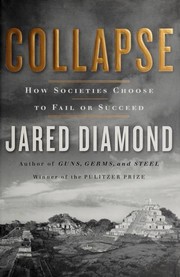
Collapse
by Jared Diamond
Diamond's direct follow-up — why some societies collapse while others survive, examining Easter Island, the Maya, the Norse Greenland settlement, and modern Montana through the same environmental and ecological lens.
- 2
 Buy on Amazon
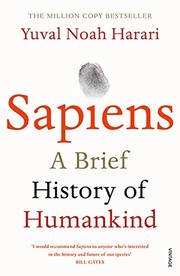
Sapiens
by Yuval Noah Harari
Harari's complementary account of how Homo sapiens rose to dominance — emphasizing the role of shared cognitive fictions (religions, nations, money) where Diamond emphasizes geography and ecology, together providing the most complete picture of human civilizational development.
- 3
 Buy on Amazon
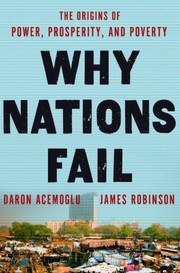
Why Nations Fail
by Daron Acemoglu
The institutional economics account of civilizational success and failure — arguing that inclusive political and economic institutions explain the differences between rich and poor nations, as the explicit intellectual counterpoint to Diamond's geographic determinism.
- 4
 Buy on Amazon
The Fate of Rome
by Kyle Harper
A historian's account of how climate change and pandemic disease — the same environmental factors Diamond discusses — reshaped and ultimately contributed to the fall of the Roman Empire, applying Diamond's analytical framework to a specific historical case.
- 5
 Buy on Amazon
The WEIRDest People in the World
by Joseph Henrich
A cultural evolutionary account of how the specific history of Western European institutions — particularly the Catholic Church's marriage rules — shaped the psychology and social organization that produced the West's economic and scientific dominance.
- 6Buy on Amazon
Plagues and Peoples
by William H. McNeill
The classic account of how infectious disease shaped human history — written in 1976, it is the intellectual ancestor of Diamond's germ argument, tracing the role of epidemic disease in the conquest of the Americas, the Mongol invasions, and other decisive historical moments.
- 7
 Buy on Amazon
The Silk Roads
by Peter Frankopan
A world history centered on Central Asia rather than Western Europe — arguing that the Silk Roads connecting Asia, the Middle East, and Europe were the true arteries of world civilization for most of human history, offering a geographic reframing that complements Diamond's analysis.
- 8Buy on Amazon
The Geography of Genius
by Eric Weiner
An account of why certain places at certain times — ancient Athens, Renaissance Florence, Enlightenment Edinburgh, Silicon Valley today — produce extraordinary concentrations of creativity, exploring the geographic and cultural conditions that foster innovation.
More Guns, Germs, and Steel Resources
More Reading Recommendations
View all →Monthly Newsletter
Never miss a big release
Get the most anticipated upcoming books delivered to your inbox once a month — no spam, no filler.
Monthly only. Unsubscribe anytime.
Book links are Amazon affiliate links. As an Amazon Associate, BookReleaseRadar earns from qualifying purchases at no extra cost to you.