Recommendations
Books Like L'Œuvre
Best books to read after L'Œuvre by Zola
If the portrait of artistic ambition and its failure in L'Œuvre — Claude Lantier's impossible masterpiece, the monumental canvas he can never complete, the painting that becomes his obsession and his doom — moved you, these eight works share its territory: the artist's life as fiction, the gap between vision and execution, and the Paris art world of the Impressionist era.
- 1Buy on Amazon
Manette Salomon
by Edmond and Jules de Goncourt
The most important predecessor of L'Œuvre in the French novel of the painter's milieu: the Goncourts' 1867 study of a group of Paris studio painters uses the same research precision that Zola brings to the Impressionist generation, and the same analysis of the destructive woman (Manette) that Zola extends in Christine's relationship with Claude.
- 2
 Buy on Amazon
Germinal
by Émile Zola
The companion masterwork in Les Rougon-Macquart: where L'Œuvre studies artistic ambition and its failure in the middle-class studio world, Germinal studies collective working-class action and its partial failure in the industrial world — both are Zola's great novels of a total commitment to an impossible goal.
- 3
 Buy on Amazon
Le Ventre de Paris
by Émile Zola
Volume 3 and Claude Lantier's first major appearance: the painter who appears in the Central Market context is already the figure who will be destroyed by his art in L'Œuvre, and reading Le Ventre de Paris illuminates how Zola developed the character across the cycle.
- 4
 Buy on Amazon
L'Éducation sentimentale
by Gustave Flaubert
Flaubert's study of a generation that fails to become what it dreamed of being is the essential predecessor of L'Œuvre's portrait of artistic failure — the same systematic demonstration that the young man's vision and ambition exceed the reality his talent can produce.
- 5Buy on Amazon
The Moon and Sixpence
by W. Somerset Maugham
Maugham's novel of a stockbroker who abandons everything for painting (based on Gauguin) is the twentieth-century parallel to L'Œuvre that inverts the ending: where Zola's Claude fails to realize his vision and kills himself, Maugham's Strickland succeeds but cannot live in ordinary life alongside his achievement.
- 6
 Buy on Amazon
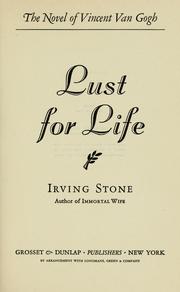
Lust for Life
by Irving Stone
Stone's biographical novel of Van Gogh is the most widely read twentieth-century descendant of L'Œuvre's structure: the artist whose vision exceeds his initial capacity, who produces extraordinary work through obsessive effort, and who is destroyed by the same intensity that made the work possible.
- 7Buy on Amazon
The Impressionists: A History
by Phoebe Pool
The historical context for the movement that L'Œuvre documents — the Impressionist debates, salons, and rejections that Zola based Claude's career on, researched partly through his friendship with Cézanne and his viewing of the Impressionist exhibitions.
- 8
 Buy on Amazon
Hunger
by Knut Hamsun
Hamsun's Norwegian novel of the starving artist who cannot stop writing despite his degradation is the most important international parallel to Claude's obsession: the same primacy of the artistic vision over all other considerations, the same inability to compromise with the world that withholds recognition.
More L'Œuvre Resources
More Reading Recommendations
View all →Monthly Newsletter
Never miss a big release
Get the most anticipated upcoming books delivered to your inbox once a month — no spam, no filler.
Monthly only. Unsubscribe anytime.
Book links are Amazon affiliate links. As an Amazon Associate, BookReleaseRadar earns from qualifying purchases at no extra cost to you.