Recommendations
Books Like Hunger
Best books to read after Hunger by Knut Hamsun
Knut Hamsun's Hunger is one of the founding texts of European literary modernism — a Norwegian novel about an unnamed writer starving in Oslo, refusing to compromise, a direct influence on Kafka, Beckett, and a century of literary fiction about consciousness and deprivation. These recommendations extend the experience through Hamsun's other novels and through modernist fiction that inherits his innovations.
- 1
 Buy on Amazon
Pan
by Knut Hamsun
Hamsun's 1894 novel about Lieutenant Glahn, a hunter alone in the Norwegian wilderness who falls in love with a local girl — lyrical, sensual, and atmospheric. The natural companion to Hunger in Hamsun's work, showing the other side of his range: Hunger is claustrophobic, urban, and interior; Pan is expansive, natural, and lyrical.
- 2
 Buy on Amazon
Growth of the Soil
by Knut Hamsun
Hamsun's 1917 Nobel Prize novel about Isak, a settler who builds a farm in the wilderness of northern Norway — the pastoral, anti-modern counterpart to Hunger's urban deprivation. Where Hunger is about consciousness untethered from the material world, Growth of the Soil is about consciousness grounded in land and work.
- 3
 Buy on Amazon
The Trial
by Franz Kafka
Kafka acknowledged Hamsun as an influence, and The Trial's nameless protagonist navigating an incomprehensible system is the Central European development of Hunger's first-person consciousness in an inexplicable situation. Both novels are about the gap between the self's experience and the institutional world's logic.
- 4
 Buy on Amazon
Molloy
by Samuel Beckett
Beckett's 1951 novel about Molloy crawling through a landscape he cannot understand is the most direct Beckettian descendant of Hunger — the same reduction to the basics of consciousness, the same refusal of narrative resolution, the same Irish-French intellectual engagement with what Hamsun began in Norwegian.
- 5
 Buy on Amazon
Martin Eden
by Jack London
London's 1909 autobiographical novel about a working-class sailor who educates himself and tries to become a writer is the American parallel to Hunger — same commitment to artistic integrity over commercial compromise, same portrait of poverty as an environment that tests the will, same unsparing ending.
- 6
 Buy on Amazon
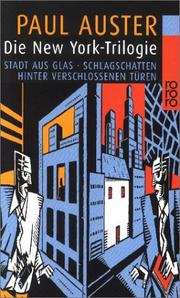
City of Glass
by Paul Auster
Auster's 1985 novel, the first of the New York Trilogy, is organized around a detective who loses himself in a case — a direct homage to Hunger's unnamed narrator's dissolution of identity in an urban environment. Auster has acknowledged Hamsun's direct influence on the New York Trilogy.
- 7
 Buy on Amazon
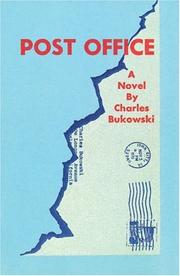
Post Office
by Charles Bukowski
Bukowski's 1971 autobiographical novel about Henry Chinaski's years at the Los Angeles post office is the American working-class counterpart to Hunger's literary-bohemian poverty — the same refusal to compromise, the same pride, the same relationship between deprivation and writing.
- 8
 Buy on Amazon
The Tartar Steppe
by Dino Buzzati
Buzzati's 1940 Italian novel about a soldier who spends his career waiting at a fort on the edge of the Tartar Steppe for an attack that never comes shares Hunger's existential quality — the consciousness waiting for something that does not arrive, the gap between expectation and experience.
More Hunger Resources
More Reading Recommendations
View all →Monthly Newsletter
Never miss a big release
Get the most anticipated upcoming books delivered to your inbox once a month — no spam, no filler.
Monthly only. Unsubscribe anytime.
Book links are Amazon affiliate links. As an Amazon Associate, BookReleaseRadar earns from qualifying purchases at no extra cost to you.